An independent guide for Liverpool homes
Solar panels Liverpool: what your own roof could do
From the terraces of Anfield and Kensington to the Georgian streets around Canning, most Liverpool homes can take solar panels, and the city's figures are better than many expect. Try your own roof on the estimator, then read on for prices, planning and help with the cost, all sourced.
Figures checked 3 November 2026 · Published independently by SEO-DONS LTD
Liverpool homes at a glance
Rooftop estimator · PVGIS 5.3, central Liverpool
What would your roof make in a year?
3,378 kWh a year
3,378 kWh a year
About 135% of the 2,500 kWh a typical home uses in a year (Ofgem). At the North West average, 3.5 kW comes to about £7,050.
PVGIS 5.3 (European Commission JRC), 14% system losses, pulled 3 November 2026; prices: DESNZ 2025/26 North West means (our arithmetic). Shade from nearby buildings is not included.
A city of terraces
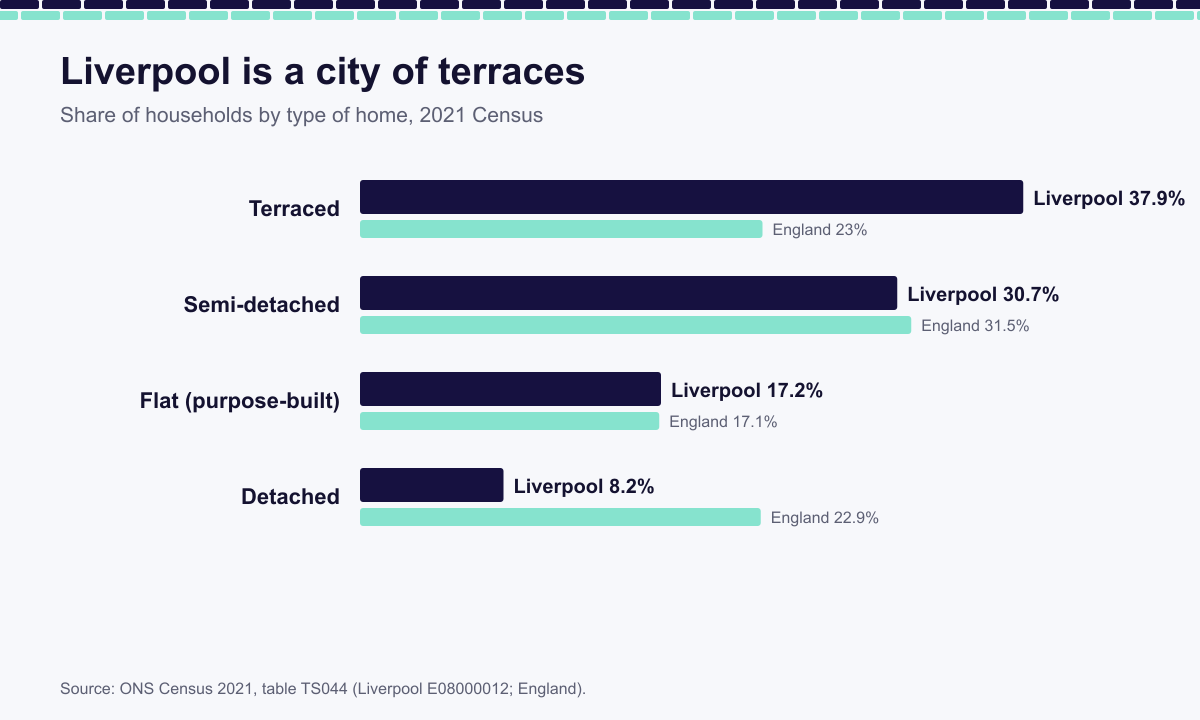
At the 2021 Census, 37.9% of Liverpool households lived in a terraced house, far above England's 23%, and only 8.2% in a detached one (ONS). In the old County ward the terraced share was 75%; in Old Swan 65.5% and in Anfield 61.1%.
A terrace usually owns both slopes of its roof, so the front and back face opposite ways and one of them tends to suit panels. What limits a terrace is space: chimney stacks on the party walls, rear offshoots and dormers all cut into the usable area, and pavement scaffolding takes some arranging. The terraced houses guide goes through each.
The semis are concentrated in the south and east: 79.9% of households in Childwall and 59.2% in Allerton and Hunts Cross. City-centre flats are a different case again: 58.4% of households in the Central ward live in a purpose-built flat, where the building's owner decides about the roof (flats and apartments).
Which way to face: west edges east here
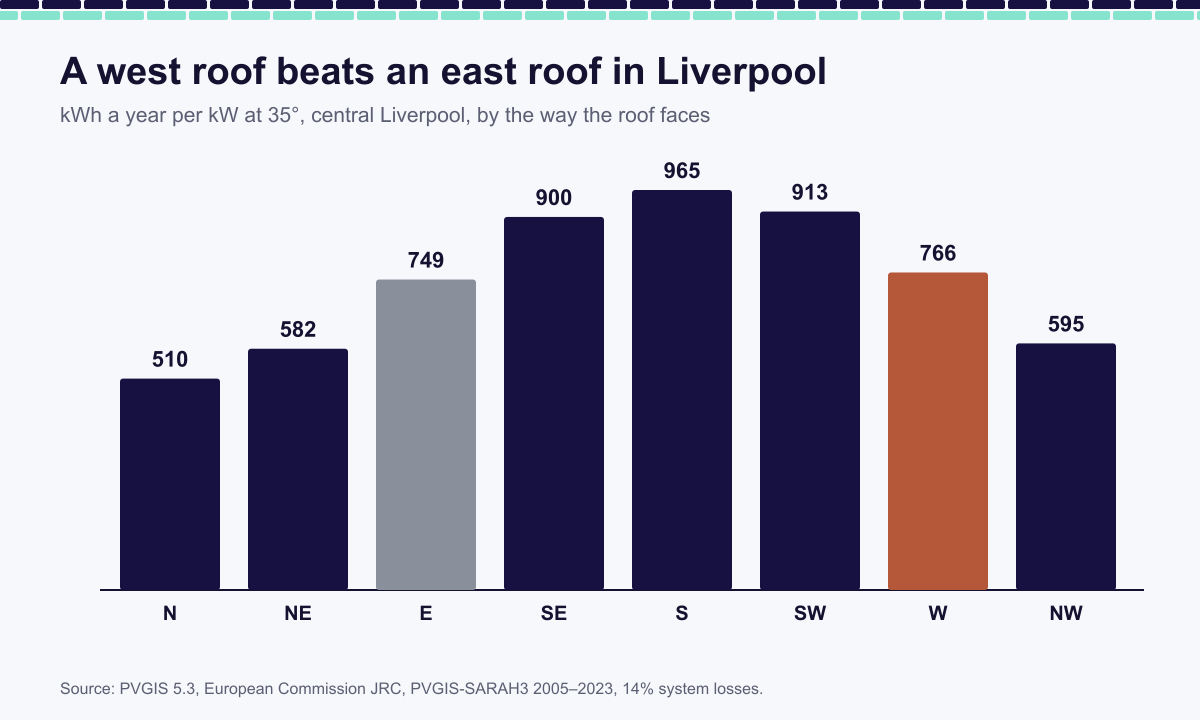
PVGIS, the European Commission's solar model, gives a south-facing roof at 35° about 965 kWh a year per kW in central Liverpool, and 968 at the best angle of about 40° (PVGIS 5.3). One local detail: a west-facing roof (766) makes a little more than an east-facing one (749). West also catches the late afternoon, when many households start using more power.
Across the city the figures barely move. The northern points we tested, from the city centre to Walton and West Derby, sit at about 965 for a south roof; the southern ones, such as Aigburth and Garston, at about 948. So your roof's direction and shade matter far more than your postcode.
Rain is not the obstacle it seems. The Met Office's 1991–2020 average at Crosby, north of the city, is 824 mm a year (Met Office), and panels generate from daylight through cloud. Is Liverpool too wet for solar?
What solar costs in the North West
The government's 2025/26 cost statistics cover 22,981 MCS-certified installations in the North West. Small systems, up to 4 kW, came to £2,021 per kW on average; systems of 4 to 10 kW to £1,768 per kW (DESNZ).
Plenty of neighbours have already done it: government figures count 8,074 solar PV installations of every size in Liverpool at the end of 2025, against 3,855 five years earlier (DESNZ).
Installed solar is zero-rated for VAT until 31 March 2027; from 1 April 2027 it carries 5% (HMRC), roughly £50 for each £1,000 of work, by our arithmetic.
| Size | Average per kW | About | kWh a year |
|---|---|---|---|
| 3 kW | £2,021 | £6,050 | 2,895 |
| 5 kW | £1,768 | £8,850 | 4,825 |
Help with the cost, and who it is for
Households that can afford panels get no grant for them in England; the Warm Homes Plan offers loans instead (Warm Homes Plan). For those on lower incomes, Liverpool City Council runs a Warm Homes: Local Grant with £5.8m from the government to improve about 450 Liverpool homes over three years, and its measures include solar PV and batteries. It is open to owners and private renters in homes at EPC D to G who live in a qualifying postcode, receive a means-tested benefit, or have gross household income under £36,000 (Liverpool City Council).
The council says the scheme is oversubscribed for its second year (1 April 2026 to 31 March 2027), and that registering now counts towards year three from 1 April 2027. Separately, the Liverpool City Region Combined Authority has run group-buying rounds for solar under the Solar Together name (LCRCA); a round is a way to get a price, not a grant.
Everyone can be paid for spare power: larger suppliers must offer an export rate under Ofgem's Smart Export Guarantee rules, each setting its own (Ofgem). All the help with the cost
Planning: Article 4 in the conservation areas
Roof panels on a house in England are normally permitted development within limits rewritten on 27 August 2026 (SI 2026/896). Liverpool's twist is how much of its older housing is protected. The city has 36 conservation areas covering 9% of its area and about 19,000 properties (Liverpool City Council), and Article 4 directions cover most of them, taking away permitted development for alterations to the roof, roof coverings, chimneys, dormers and roof lights among other things (Liverpool City Council).
The council's page does not mention solar panels directly, so in a conservation area ask the planning team before committing. In Kensington Fields, Knotty Ash, Toxteth Park and the Avenues, the directions apply only to elevations that front a highway. Historic England lists 1,527 entries in the city (Heritage Counts); a listed building always needs consent. The planning guide
The grid: SP Energy Networks
Liverpool's network belongs to SP Energy Networks. For a single generator under 16 amps per phase (3.68 kW), it says you must inform it before or at the time of commissioning, a legal obligation, and send the commissioning confirmation within 30 days; it will not normally object (SP Energy Networks). Larger systems and batteries that take you past the limit need its agreement first.
Older homes and the EPC
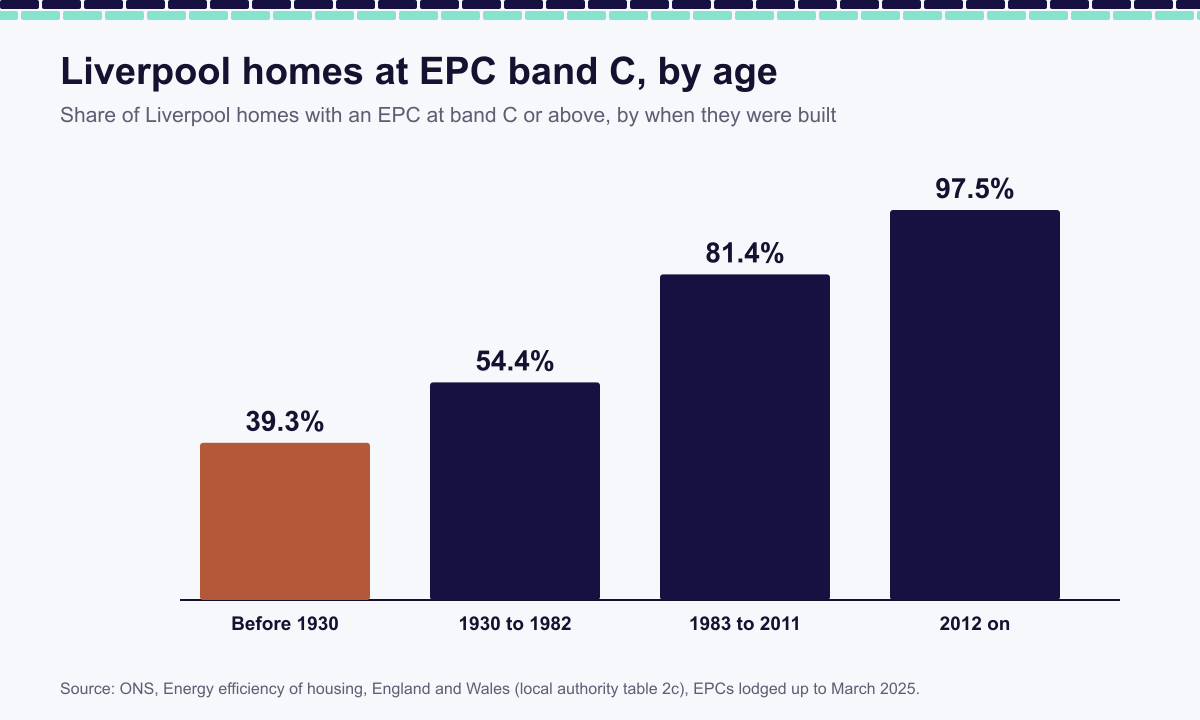
30.9% of the 243,710 properties on Liverpool's council tax list were built before 1919, and 25.6% before 1900 (VOA 2026). Even so, 60.2% of Liverpool homes with an EPC reach band C, more than England's 53.3%, and 75.3% of the city's flats do; among homes built before 1930 the figure is 39.3% (ONS).
Panels lift a rating and cut what you buy from the grid, but in a solid-walled Victorian house insulation usually comes first for comfort. Georgian and Victorian homes
Renting? 26.1% of Liverpool households rent privately, and the council's landlord licensing scheme covers around 80% of the private rented sector for 1 April 2022 to 31 March 2027 (Liverpool City Council). Renting and solar
Before you sign anything
We do not install anything or point you to a particular firm. What we can do is list the checks worth making on any installer: registration with MCS, membership of RECC, HIES or another approved code, a price broken down in writing, and a protected deposit.
- Ask which slope the panels go on and what each would make; compare with the estimator.
- Divide the price by the kW and compare with the North West average.
- In a conservation area, ask how the design deals with the Article 4 direction.
- Confirm who notifies SP Energy Networks, and when.
Five questions Liverpool readers ask first
Are solar panels worth it in Liverpool?
Liverpool does well for a northern city: PVGIS gives a south-facing roof about 965 kWh a year per kW in the city centre. Whether panels suit your home depends on the roof you have, shade and when you use electricity.
Is a west-facing roof better than east in Liverpool?
Slightly. In central Liverpool PVGIS gives a west roof at 35° about 766 kWh a year per kW and an east roof 749. Both are worth considering, and west catches the late afternoon when many households are home.
Do I need planning permission for solar panels in Liverpool?
Usually not on a house roof within the national limits. But Article 4 directions cover most of Liverpool's 36 conservation areas and include roof alterations, so in a conservation area ask the council first; listed buildings always need consent.
Is there help with the cost of solar in Liverpool?
For households that qualify, Liverpool City Council's Warm Homes: Local Grant includes solar PV and batteries: homes at EPC D to G with income under £36,000, a means-tested benefit or a qualifying postcode. It is oversubscribed for its second year. Everyone pays 0% VAT on installed solar until 31 March 2027.
Who connects solar panels in Liverpool?
SP Energy Networks runs the Liverpool network. For a system under 16 amps per phase (3.68 kW), the installer must tell SP Energy Networks before or at commissioning and send the commissioning confirmation within 30 days.
Ask about solar on your Liverpool home
Tell us the area, the kind of house and what you would like to know. Your message goes to SEO-DONS LTD, who publish this Liverpool guide, and we write back by email. No visits, no phone calls, no charge.
What happens next
- SEO-DONS LTD, publisher of this guide, receives your message.
- We read it and write back by email.
- Nothing is signed or arranged by asking.